
.webp)


How Does a Pergola Provide Shade?
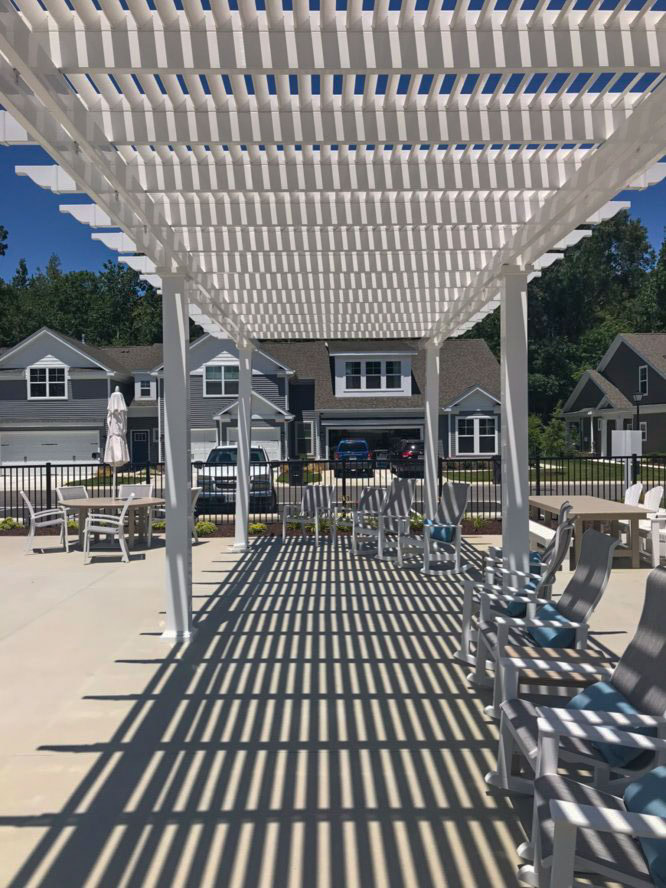
A pergola provides shade by interrupting direct sunlight with overhead rafters, slats, or louvers that cast shadows on the space below. How much shade it actually delivers runs from about 20% with widely spaced rafters up to 100% with closed louvers or a solid top. Four things decide where a pergola lands in that range: how deep the rafters are, how wide the gaps between them are, which direction they run, and where the sun sits in the sky at the hour you are standing underneath. Below we work through each one, including the geometry that tells you exactly when a fixed pergola stops filtering sun and starts blocking it outright.
How Does a Pergola Provide Shade?
A pergola provides shade by placing solid material between the sun and the ground, and every rafter overhead casts a shadow the width of the board that made it. Those shadows fall in stripes rather than as a single sheet, which is why a pergola produces the banded, dappled light people associate with the structure instead of the flat darkness of a roof.
Stripe width and stripe spacing are what separate a decorative pergola from a genuinely comfortable one. Narrow boards spread far apart throw thin shadows with wide bright gaps between them. Deep boards packed close together throw wide shadows that overlap into continuous shade. The structure looks similar in a photo either way, so the difference only shows up when someone sits underneath at one in the afternoon. That is the calculation we run on every pergola build before the rafter size is settled.
How Much Shade Does a Pergola Provide?
A pergola provides between 20% and 100% shade coverage, depending entirely on the roof configuration. A traditional garden pergola with wide-spaced rafters sits near the bottom of that range, while a closed louvered roof reaches the top. The table below reconciles the coverage figures published by StruXure NorCal and the aluminium manufacturer Progolas, and adds what each level actually feels like underneath.
Roof ConfigurationShade CoverageWhat It Feels Like UnderneathWide-spaced open rafters, 6 inch gaps20% to 40%Bright dappled light, sunglasses still needed at middayTight fixed slats, 3 inch gaps60% to 65%Comfortable for dining through most of the dayDeep rafters with tight gaps65% to 90%Dense shade except in the hour either side of solar noonAdjustable or motorized louvers40% to 100%Whatever you set it to, changeable by the hourClosed louvers or solid panel roof100%Full shade plus rain protection, darker and less airyFabric canopy or shade sail90% to 98% of UV blockedSoft diffuse shade, cooler, no rain protection
Dappled shade is the term for what the first two rows produce, meaning bright spots and shaded spots in roughly equal measure as the shadows fall in stripes. Full shade requires either continuous overlap of those stripes, a fabric layer, or a closed roof. Dappled light suits a morning coffee spot and keeps climbing plants alive. Dining, working on a laptop, or sitting for two hours in July calls for something denser. The visual difference between those configurations is easier to see than to describe, and the range of pergola styles shows how differently the same structure can read.
What Determines How Much Shade a Pergola Provides?
Four variables determine how much shade a pergola provides: rafter depth, the gap between rafters, the direction the rafters run, and the sun's angle at a given moment. Most guides name only the last three. Rafter depth is the one that gets left out, and it does more work than any single factor besides the sun itself.
The Depth-to-Gap Ratio
The depth-to-gap ratio is the relationship between how far a rafter projects downward and how wide the opening beside it is, and that ratio sets the sun angle at which a fixed pergola stops filtering and starts fully blocking. Picture a sunbeam slipping through a gap. To reach the ground it has to travel sideways across the width of that gap while dropping the depth of the rafter. When the rafter is deep enough relative to the gap, the beam runs into the side of the board before it clears the opening.
Running that geometry produces a cutoff angle for any rafter and gap combination. Below the cutoff, direct sun is blocked entirely. Above it, sun passes through the gaps and the coverage falls back to the ratio of board width to opening width.
Rafter Size and GapDepthCutoff Sun AngleResult2x4 on edge, 6 inch gaps3.5 inchesAbout 30 degreesBlocks direct sun only early and late in the day2x4 on edge, 3 inch gaps3.5 inchesAbout 49 degreesBlocks direct sun outside the midday hours2x6 on edge, 3 inch gaps5.5 inchesAbout 61 degreesBlocks direct sun through most of the day2x8 on edge, 4 inch gaps7.25 inchesAbout 61 degreesSame cutoff with a wider opening and more airflow2x10 on edge, 4 inch gaps9.25 inchesAbout 67 degreesBlocks direct sun at every hour of the year at our latitude
Those figures apply across the slats, meaning in the plane the sun crosses as it moves relative to the rafter direction. The practical takeaway is that deepening the rafters buys more shade than tightening the gaps does, and it buys it without closing the roof in. Two inches of extra rafter depth moves the cutoff angle further than an inch of tighter spacing, and the wider opening keeps air moving. Most pergolas get built with 2x6 rafters because that is what looks proportional, not because anyone checked the angle.
How Does Sun Angle Change the Shade a Pergola Casts?
Sun angle changes pergola shade constantly, because the sun traces an arc that shifts by the hour and by the season. Early and late in the day the sun sits low and its rays come in almost sideways, slipping under the structure entirely. Near solar noon the sun sits at its highest and the rays come down steeply, which is when the gaps between rafters matter most.
Latitude sets the ceiling on that arc, and this is where most pergola advice goes wrong for homeowners here. Northern California sits around 37 to 38 degrees north, where StruXure NorCal measures noon sun at roughly 76 degrees at the summer solstice and 29 degrees at the winter solstice. Central Washington sits near 47.4 degrees north, which puts our noon sun at roughly 66 degrees in late June, 42.6 degrees at the equinoxes, and 19.1 degrees in late December.
That ten-degree difference at the top of the arc works in our favour. A rafter and gap combination that leaks midday sun in Sacramento or Phoenix can block it completely at our latitude, because the sun never climbs high enough to shoot straight down through the openings. A pergola designed off national averages is usually more open than it needs to be here. Sun path also interacts with where the structure sits relative to the house and the trees, so pergola placement changes the answer as much as the roof does.
Which Direction Should Pergola Rafters Run for the Most Shade?
Pergola rafters should run east to west for the most midday shade, and north to south for the most morning and evening shade. Rafters running east to west sit perpendicular to the sun's path at noon, so every board casts its full shadow straight down during the hottest hours from roughly 11 AM to 3 PM.
Rafters running north to south do the opposite. At noon they sit parallel to the sun's position and the light pours through the gaps, but in the early morning and late afternoon the low sun strikes them from the side and each board throws a long shadow across the space. Neither orientation is correct in the abstract. The right answer comes from the hours the space will actually get used, so a breakfast patio and a lunch patio should be built differently. Photographs of both orientations sit in our finished pergolas collection.
Does a Pergola Actually Give Shade?
Yes, a pergola actually gives shade, though a traditional open-rafter design gives partial shade rather than full shade. Progolas measures a wooden pergola with widely spaced rafters at 20% to 30% coverage at noon, which is real relief from glare but is not the same as sitting under a roof. Expecting a roof and receiving a filter is the single most common disappointment with a new pergola.
Filtering is still worth a great deal in practice. Shade combined with moving air can feel 10 to 15 degrees cooler than standing in direct sun, and research published in the Journal of Facade Design and Engineering found that adjustable shading systems reduce solar heat gain coefficient by up to 85% compared with exposed surfaces. The structure does not lower the air temperature. It lowers the radiant load hitting your skin and the surface temperature of everything underneath.
What Is the Point of a Pergola Without a Solid Roof?
The point of a pergola without a solid roof is airflow, light quality, and seasonal flexibility, all three of which a closed roof gives up. Heat that collects under a structure needs somewhere to go. Open rafters let hot air rise straight out through the gaps, which sets up a convection current that keeps pulling cooler air in at the edges. A solid patio cover stops that exchange and can turn into a heat trap on a still afternoon.
Seasonal flexibility is the argument that matters most in a four-season climate. With the December sun sitting at roughly 19 degrees, an open pergola lets winter light reach a patio and the wall of the house behind it, which is warmth you want in January and shade you want in July. A fixed solid roof blocks both equally. Climbing plants work on the same principle, since deciduous vines leaf out for summer shade and drop their leaves to let winter sun through. Open structures also behave differently from enclosed ones, which is the practical heart of the pergola vs gazebo distinction.
How to Get More Shade From a Pergola
You can get more shade from a pergola with seven upgrades, listed here from the easiest retrofit to the most involved:
- Add battens between the existing rafters. Fastening additional boards into the gaps narrows the openings without touching the frame. Moving from 6 inch gaps to 3 inch gaps roughly doubles coverage.
- Run a shade cloth or fabric canopy under the rafters. The fastest fix on an existing structure. Specification matters more than most people realise, since fabric with a 5% openness factor blocks 95% of UV while a loose weave may block only 50%. Look for UPF 50+ material, which filters more than 98% of UV.
- Install a retractable cover on a wire or track. Same fabric benefit with the option to pull it back for winter sun or stargazing.
- Swap the fixed top for adjustable louvers. Louvers tilt through the full range from open to closed, which is the only configuration that answers the sun-angle problem at every hour instead of one.
- Add side screens on the west face. Overhead structure does nothing against a low sun. Drop-down screens block 90% to 95% of UV and are the fix for a patio that becomes unusable after 4 PM.
- Grow climbing plants across the rafters. Wisteria, grapevines, and similar climbers build a living canopy that shades in summer and thins in winter. The trade-off is several seasons of growth and ongoing pruning.
- Size the structure up or reposition it. The most involved option and sometimes the only real one, because a pergola that is simply too small will never shade the table no matter what goes on top.
Fabric colour is worth one note alongside those options. Light aluminium and light fabric reflect roughly 70% to 80% of solar radiation while dark surfaces absorb it and radiate that heat downward, so a white louver blade runs cooler over a dining table than a black one. We specify the shade layer at design stage on custom pergolas rather than leaving it as an afterthought.
How Do You Design a Pergola for Shade?
You design a pergola for shade by sizing it against the shadow, not against the furniture. A shadow sits directly under the structure only at solar noon. By mid-afternoon it has drifted east, and Progolas notes that a 10 by 12 pergola covering 120 square feet may deliver only about 80 square feet of usable shade by 3 PM once that drift is accounted for.
Shadow drift is why a pergola built to match a table footprint leaves the end chairs in the sun. A structure two to four feet larger than the seating area in the direction the shadow travels solves it, and that extra span is far cheaper to build now than to add later. Post height plays into the same calculation, since a taller structure lets more low-angle light in at the sides while a lower one feels darker and closer. Eight to ten feet at the beam is the working range for most patios, and taller posts carry more load down into the pergola footings at the base.
Adding a solid or louvered top changes the structure rather than just the surface. A closed roof collects snow, and a covered pergola in this region has to be framed and footed for that load rather than treated as an open frame with a lid. Those requirements run through the whole build, and an attached pergola carries part of that load into the house wall at the ledger.
Which Is Better, a Wood or Metal Pergola, for Shade?
Wood is better for deep fixed shade and metal is better for adjustable shade, because each material allows a different kind of roof. Wood rafters can be built deep at low cost, and depth is what drives the cutoff angle. A 2x10 cedar rafter is a routine piece of lumber, while an aluminium extrusion of the same depth is neither standard nor cheap.
Metal earns its place through louvers and spans. Aluminium louver systems tilt and close in ways no fixed wood roof can match, and metal carries longer spans with slimmer members, which means fewer posts interrupting the space. Surface behaviour differs too, since light-coloured aluminium reflects most of the solar radiation striking it while dark-stained wood absorbs and re-radiates heat downward. Either material needs a base rated for the structure's weight and wind exposure, and anchoring is sized to the finished roof rather than the bare frame.
What to Get Right When Designing a Pergola for Shade
Getting a shade-focused pergola right comes down to a short list of decisions that are easy to settle before the build and expensive to change afterward:
- Pick rafter depth on purpose. Depth is the highest-leverage variable and the one most often chosen for looks alone
- Orient the rafters to the hours you will use the space, rather than to whatever lines up with the house
- Design around the local sun arc, since a plan drawn for a southern latitude will be more open than this one needs
- Size past the furniture so shadow drift does not push half the seating into the sun by mid-afternoon
- Plan the west side separately, because no overhead structure handles low evening sun without vertical screening
- Decide about a solid top before framing, since a covered roof changes the snow load the whole structure carries
Getting those six right produces a space people actually sit in, and daily use is the return that matters most. A well-built structure also contributes to what a property is worth, and pergola value tracks how usable the space is rather than how large it looks.
Usability comes down to the shade design more than anything else. It decides whether the structure gets used every evening or admired from the kitchen window, which makes it the part of an outdoor living space most worth slowing down for.
Frequently Asked Questions
Does a Pergola Block Rain?
A traditional open-rafter pergola does not block rain, since the gaps that let air through let water through as well. Louvered aluminium pergolas do block rain when the blades close, because the blades interlock and the frame carries internal gutters that channel water down through the posts. Fabric canopies sit in between, and breathable shade cloth sheds most UV while letting water pass straight through.
How Much Shade Does a 10x12 Pergola Provide?
A 10 by 12 pergola covers 120 square feet of ground at solar noon, and considerably less at other hours. Shadow drift moves the shaded area east through the afternoon, so usable shade can drop to roughly 80 square feet by 3 PM. Coverage density within that footprint depends on the roof, ranging from 20% with wide-spaced rafters to 100% with a closed top.
Do Louvered Pergolas Provide Shade When Open?
Yes, louvered pergolas provide shade when open, because the blades themselves cast shadows at any angle other than perfectly parallel to the sun's rays. Open louvers produce a striped shade pattern that cuts glare without closing the roof in. Coverage rises as the blades tilt, reaching 100% when they close fully.
Will a Pergola Provide Shade in the Morning?
A pergola provides morning shade when the rafters run north to south, since the low eastern sun strikes those boards from the side and casts long shadows across the space. Rafters running east to west give weak morning shade because the rising sun passes through the gaps almost horizontally. Adjustable louvers sidestep the problem by tilting to meet whatever angle the sun is at.
Does a Pergola Reduce Heat?
A pergola reduces the heat you feel without lowering the air temperature. Shade cuts the radiant energy landing on skin and drops the surface temperature of the patio, furniture, and table underneath. Airflow does the rest, and the combination can feel 10 to 15 degrees cooler than direct sun. Open rafters help here in a way solid roofs cannot, since rising hot air escapes through the gaps instead of collecting under a lid.
Can You Add Shade to an Existing Pergola?
Yes, you can add shade to an existing pergola without rebuilding it. Battens fastened between the existing rafters narrow the gaps, a shade cloth or canopy run beneath the rafters adds a fabric layer, and drop-down screens on the west face handle low evening sun. Each of those works on a finished structure. Replacing a fixed top with adjustable louvers is the one upgrade that usually requires reworking the frame.
The Bottom Line
A pergola provides shade by interrupting sunlight with overhead structure, and how much shade you get is an engineering outcome rather than a fixed property of the word "pergola." Rafter depth sets the cutoff angle, gap width sets the baseline coverage, orientation decides which hours get shaded, and the sun's arc decides the rest. Coverage runs from 20% for wide-spaced rafters to 100% for a closed louvered roof, with fabric, screens, and plants available at every point in between.
The local sun works in our favour on this one. Noon sun here tops out near 66 degrees rather than the 76 degrees a Bay Area designer plans around, which means a well-specified fixed pergola can hold dense shade through the day without closing the roof in and giving up the winter light. Around East Wenatchee we spend more time on rafter depth and orientation than on anything else, because those two decisions are what people feel in August. If you want help sizing a structure for the hours you will actually use it, AZ Builders is glad to walk the yard with you.
Reach out whenever you want a free estimate.
.webp)

.webp)
.webp)
You May Also Like

.webp)
%201.webp)
%202.webp)
%203.webp)
.webp)


.avif)